
Single-Hand Post-Mech Writing Cores



"The Wayward Kitten" a Cautionary Tale
When I was a young and foolhardy, my friend Kent and I polished off his father’s bottle of Henry McKenna sour mash whiskey. We had to replace it before his dad returned from downrange.
Our friend Mike said he could help, for a price. He drove me to a house in his VW bug. Mike took the money and got out of the car, leaving the door open. He told me to stay in the car.
I watched kittens playing in the yard while waiting. He returned after a few minutes and started driving towards Playalinda beach to waste some time while waiting for the booze to arrive. He turned the car around just before reaching the beach.
While talking, he suddenly got very angry with me, then calmed right back down. We talked a wee bit more and then he went totally ballistic. He drove with one hand, prepared to clobber me with the other one and screamed, “If you do that again I am going to knock you head off”.
I was confused as to why he was suddenly spewing anger, and terrified of what was coming my way. Mike was monstrously strong. If he liked you, he would punch your shoulder as a greeting. I had collected a lot of bruises from Mike.
I started waving my hands around in front of me and pleaded, “What am I doing to you Mike?” He got this confused and surprised look on his face. Then… a light bulb appeared over his head.
As we traveled down the road he reached under his knee and produced a soft fuzzy kitten, then handed it to me with no explanation… none was needed.
The cute little wayward kitten had been all lovey-dovey with Mike’s leg. Although totally innocent, I came close to being walloped into the next life because of that adventurous little stowaway!
Ronald Earl Walker — Ambivalent Feline Aficionado
Concomitant Designs for Single-Hand Writers
The aforementioned two-hand Post-Mechanical keyboard would be the sad undoing of a single-hand writer.
That writer will struggle to navigate the well-designed Dvorak scheme, endlessly jumping back-and-forth from one side of the keyboard to the other. The innovative “Λ” shaped gap between the two banks of the split character key array will make those jumps progressively wider, moving downward.
Inventing the quintessential two-handed alphanumeric keyboard has engendered an innate obligation to provide efficient alternatives for single-hand writers. The Dvorak single-hand letter sequences provide the foundation of very serviceable alternative Post-Mechanical keyboards for single-hand writers.
A writing core that is specifically tailored for single-hand writers must have the character keys aligned upon the natural biomechanical angle of either the right-hand or left-hand.
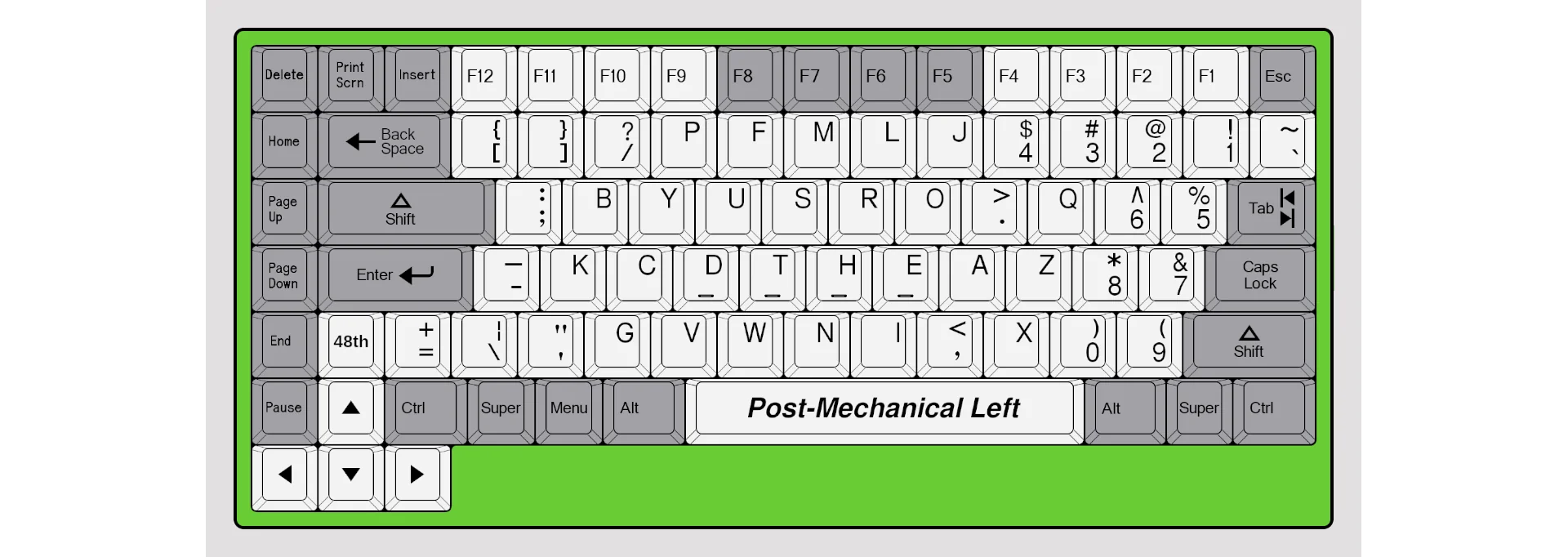
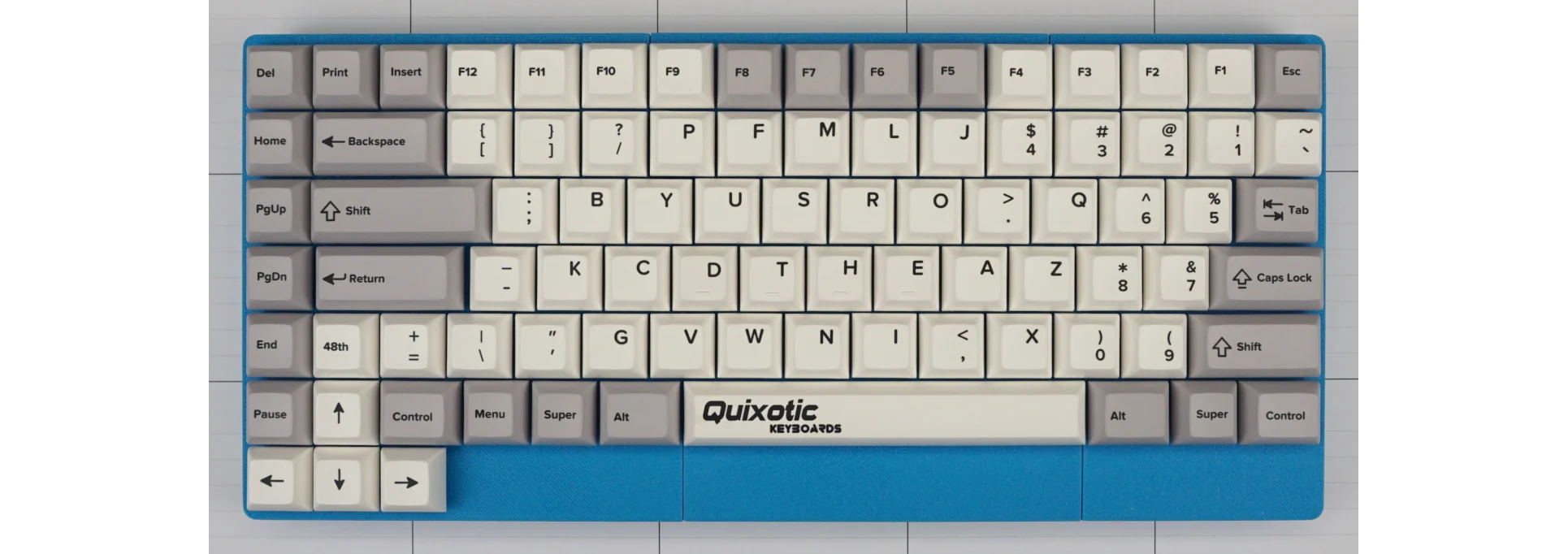
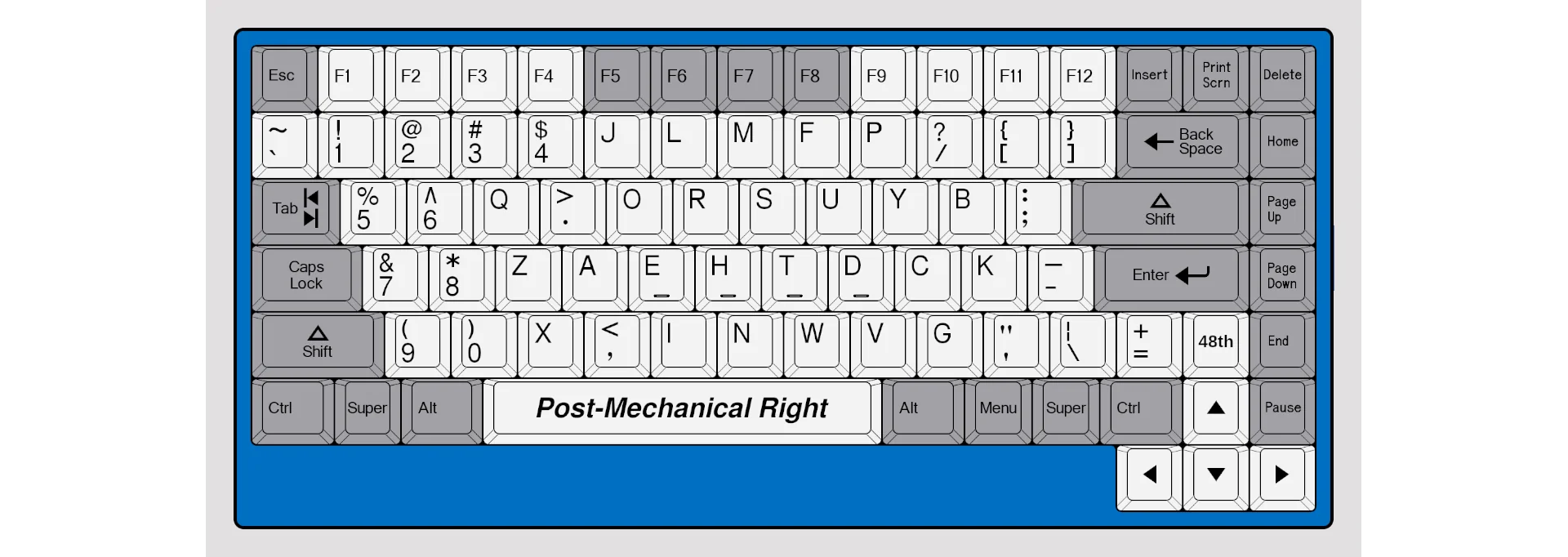
The Post-Mechanical Right layout includes an improved monolithic character key array that is organized in linear angled key columns, which are aligned with the fingers of the single-hand operator. The Post-Mechanical Left layout is a mirrored image version of the Right.
The original left-handed Dvorak letter scheme differed from the right-handed due to the mechanical typewriter keyboard’s asymmetric configuration. Without mechanical design constraints there is no need for divergent letter schemes. Studying both schemes, I concluded that the “comma” and “period” keys are used a lot more often than the “Q” and “X” keys. The right-handed letter scheme is the better choice to populate the single-hand keyboards.
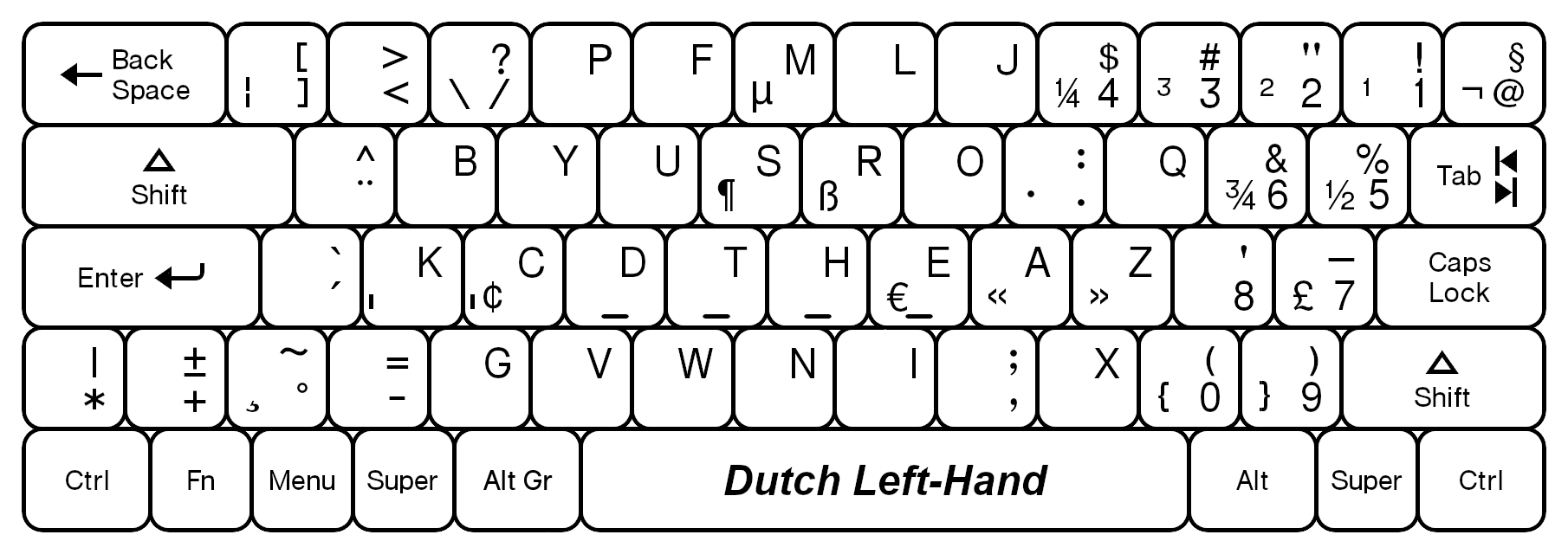
Single-hand Post-Mechanical Dvorak writing instruments can be made for any language using the Greek, Latin, or Cyrillic alphabets. The community does not have to depend upon large PC manufacturers. Although my handmade keyboards are plain looking, they are robust… They could outlast store-bought fare, you city slicker.
Ronald Earl Walker — Champion of Single-Hand Writers
Single-Hand Post-Mechanical Writing Core Keyboards

Actualizing Serviceable Single-Hand Keyboards
“For me, an external keyboard is better than the built-in keyboard on my laptop, since I can place it closer to my typing hand and limit overextending my shoulder on one side to reach the keys. And a compact keyboard with a smaller footprint makes it easier for my hand to zip from one side to the other.” (Young 2021)
For utility, the single-hand Post-Mechanical desktop keyboards have the cursor and navigation keys positioned on the near strong side. Optimal alignment between human and keyboard occurs near the far weak side of the writing core.
The sticky-keys accessibility function makes single-hand use of a keyboard practical. However, the traditional location of the near strong-side “Shift” key is less than optimal. A writer must drop below home-position to avoid an awkward under-the-hand reach. Reaches for keys above home-position takes less time and effort.
Therefore, the strong-side “Shift” key is widened and relocated to the near end of the top alpha-row; the remaining carriage control keys are placed in conventional positions. Reaches for that relocated “Shift” key using the extended outer fingers are comfortable… less stressful than reaching for a key under the hand with curled fingers.
The Post-Mechanical Left keyboard has the primary letters aligned on the right side of the keycaps. Left-hand keyboards for languages that require the use of “Alt Gr” should have those tertiary characters aligned on the left side of the keycaps, matching the relocated “Alt Gr” key. Left-hand writers can more easily read the key and understand which primary, secondary, or tertiary character a keystroke will produce.
With the numeric character key sequences reversed inside the Post-Mechanical Left writing core, it does appear reasonable to also reverse the “function” key sequences on the keyboard. By reversing all numeric sequences on the Left Post-Mechanical, the foreseeable mental gymnastics required to operate the instrument are mitigated.
Please Note: These new designs are meant for young writers. The changes will distress experienced Dvorak single-hand users. It would be impractical for me to embrace holdover legacy features. If that what you desire, then you should cling onto convention.
Ronald Earl Walker — Yixpukejoqa (A Left-Handed joke)
Single-Hand Post-Mechanical Cores for Other Than English
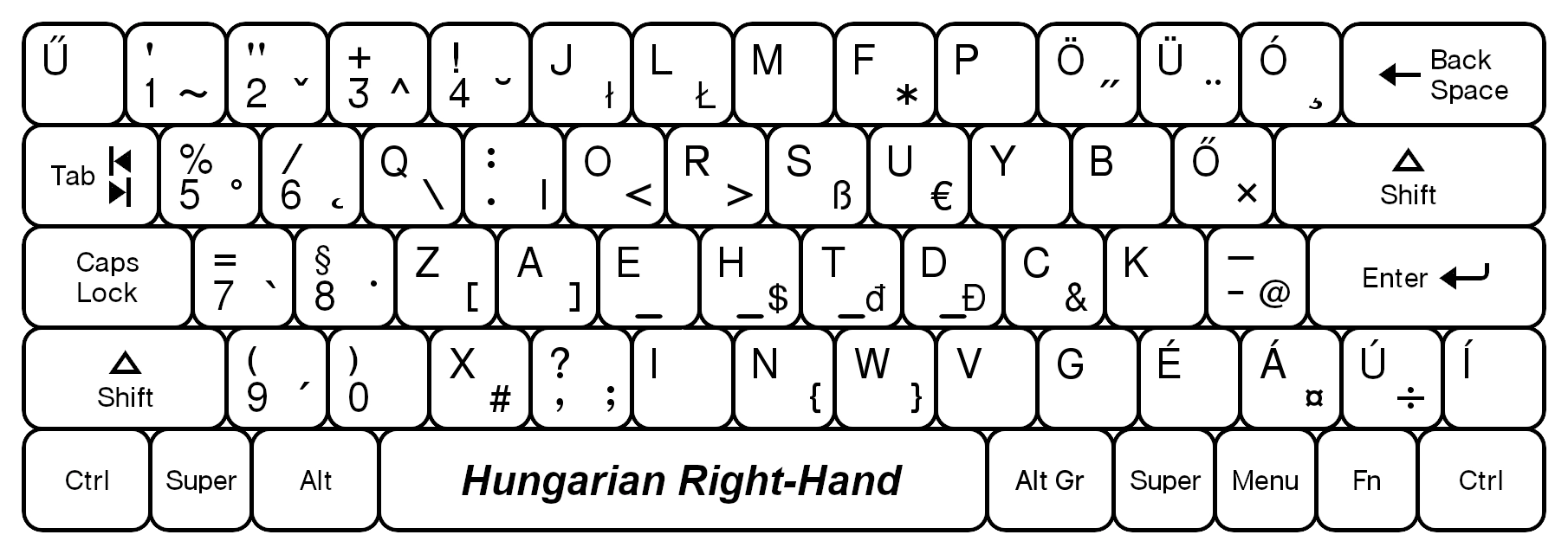
The Post-Mechanical Trust Bids You Welcome
YUZU Custom Keycaps has made die-sub keycap sets to populate my Post-Mechanical family of keyboards since May 2025. No new custom keycap sizes, just substitutions of currently molded keycaps with the correct legends.
I do wish it was simple, easy, and inexpensive to kick the 152-year-old Qwerty hegemony to the curb… It is not!
The trust has been moving closer to creating some video content.
Three videos are being proposed:
1. An introduction to Post Mechanical keyboards.
2. Making a 3D printed keyboard case.
3. Building up a PCB.
4. Programming a keyboard.
An obligatory pitch must be made. Seeing is believing, it is unfortunate for all that I must show my old ugly mug. I have a branded YouTube channel just waiting around.
The trust purchased an Epson label printer for production keyboards in November 2024. I have used that printer to make the keycap labels need to use a generic XDA keycap set and product labels will be affixed to the case bottom.
I did have a Florida business license for two years. That was allowed to lapse on May 01 2026. There no way I can afford to pay for the certifications needed to obey the law… i.e. FCC, UL, CE, RoHS, WEEE, et cetera.
Aside from enforcing the monopoly and fixing prices, the Post-Mechanical Trust will conduct business lawfully… LOL
Ronald Earl Walker — Keyboard Evolution Pathfinder
References in Order of Appearance
Herzog et al. “Bio-Mechanical Keyboard Structure and Method.”
U.S. Pat. No. 4,669,903 – June 2, 1987.
Sholes, C. Latham. “Type-Writing Machine.”
U.S. Pat. No. 207,559 – August 27, 1878.
Yasuoka, Koichi and Yasuoka, Makoto. “On the Prehistory of QWERTY.”
Zinbun, no.42, 2011, pp. 161-174.
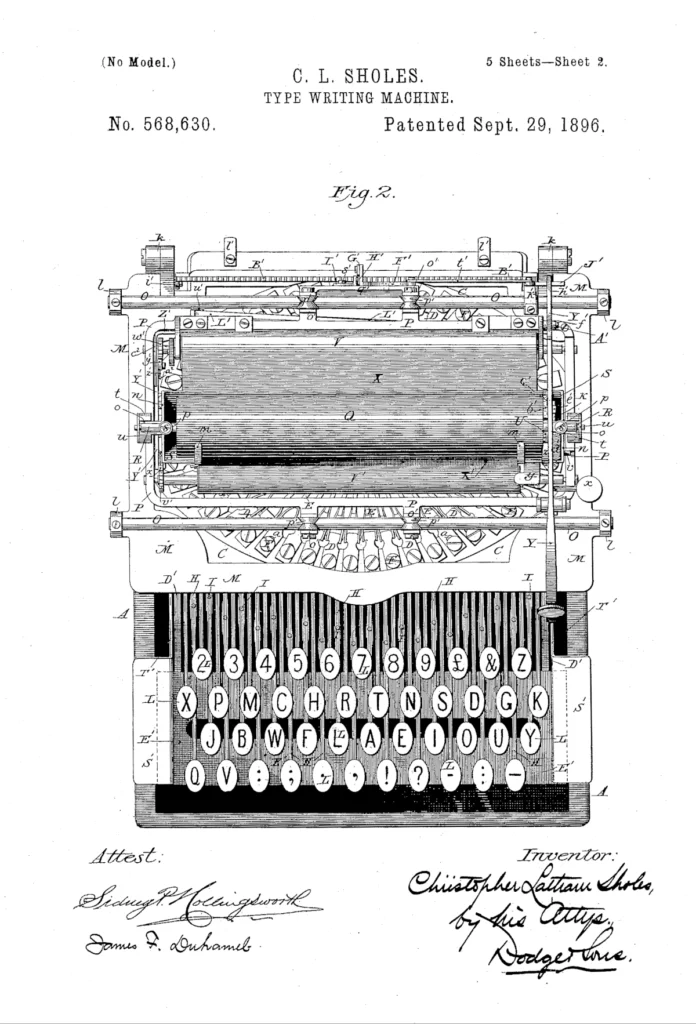
Sholes, Christopher Latham. “Type-Writing Machine.”
U.S. Pat. No. 568,630 – September 29, 1896.
Dvorak et al. “Typewriter Keyboard.”
U.S. Pat. No. 2,040,248 – May 12, 1936.
Dvorak, August, et al. “Typewriting Behavior.” American Book Company, 1936.
Liebowitz, Stan and Margolis, Stephen. “Typing Errors.”
Reason Magazine, June 1996.
Lewis, Richard. “Scientific One-Hand Typing.”
Popular Science, no. 148, March 1946, pp. 131-133.
Young, Britt H. (2021, August 9). “A One-Handed Writer’s Search for the Perfect Mechanical Keyboard.”
Wirecutter. https://www.nytimes.com/wirecutter/blog/search-for-the-perfect-mechanical-keyboard/. Accessed 29 Sept. 2024.
Ronald Earl Walker — Jackleg Bibliographer